
Are you participating in the 2018 Catholic Reading Challenge? If not, it’s not too late to start — join us! I share my picks for each category about once a month. So far, my choices are spot on for me, and my second read gets a universal recommendation if you want to improve your prayer life…

Category: “A Book on Catholic Prayer”
My Pick: Time for God by Jacques Philippe
My husband had read this book a couple of months ago and highly recommended it to me, and what do you know…it checks off a box on the reading challenge. Boy, was he right; it is good. But apparently everything by Jacques Philippe is great, according to a friend of mine. This was my first time reading one of his books.
Two motivations to read this book:
#1 — It’s really short — about 100 pages.
#2 — It may be the most helpful book on mental prayer that you ever read.
I say the most helpful, not necessarily the best. Philippe references all of the great works by saints who were quite advanced in mental prayer (Teresa of Avila, Francis de Sales, St. John of the Cross, St. Catherine of Siena, etc.). But sometimes, as Philippe notes, in our modern times we have trouble getting to the root of what these great contemplatives teach us about communing with God.
Philippe’s definition of mental prayer:
“…facing God in solitude and silence for a time in order to enter into intimate, loving communion with him.”
His bottom line:
“Mental prayer is basically no more than an exercise in loving God.”
Philippe was exactly who I needed to read on mental prayer, because he concisely and beautifully gets to the heart of why and how this type of prayer should be a daily habit. He essentially reminds us that silent, mental prayer is all about loving God. There is not a magic “technique” that you can manipulate, he says, because communion with God is a grace, a gift, from God. It is not something that we conjure up. Philippe says that we have to simply come to mental prayer with the intention of loving God, with humility, out of our poverty, and be faithful to continue coming daily.
I think this excerpt from the book puts it well:
“What ensures progress in the life of prayer, what make it fruitful, is not so much how we pray as our inner dispositions in beginning and continuing it. Our principle task is to try to acquire, keep, and deepen those dispositions of the heart. God will do the rest.”
Before this book, I had recently read Francis de Sales’ Introduction to the Devout Life, and I was inspired by his detailed account of the steps of mental prayer, and I wanted to begin this habit in earnest. (Previous descriptions of mental prayer hadn’t be so clear for me.) However, Philippe’s book is just what I needed to read on the heels of that. It helped me develop the correct attitude toward silent prayer, to remember the ultimate purpose of loving God and entering into a deeper communion with him — as he leads.
What did you read for “a book on Catholic prayer”?

Copyright 2018 Jessica Ptomey
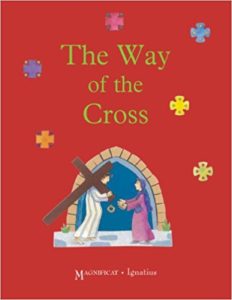 I love the tradition of praying the Stations of the Cross on Fridays during Lent, and I love doing it in our home around our prayer table. Sometimes it’s just our family, and other times it’s us and another family or two after sharing a simple soup super. But those of us with lots of young kids can find instituting the practice of praying the Stations (and other prayers) a bit daunting. It’s hard for them to sit still for that long when they are at young ages. They just don’t have the attention span and patience (especially in the evening) for the full blown version.
 As we begin the season of Lent there can be a lot of chatter about fasting, and we want to guard our hearts against missing the point entirely. It’s good to give up the things in our lives to which we tend to become attached. It’s not a bad thing that we give up social media, television, desserts, shopping, etc. We can all agree that in the course of a year we have probably packed a great deal of *stuff* into our lives that needs cleaned out. But if we mentally check a “fasting” box and move on, then we are going to miss the point of our fasting — to miss God’s idea of fasting — this Lent.